Best Orthopedic Dog Beds for Large Breeds: A Practical Buyer's Guide
A practical, vet-aware guide to choosing an orthopedic bed for large breed dogs, with checklists for size, foam type, washability, and where to actually place the bed.
Disclosure: As an Amazon Associate, TrustyPetSupplies earns from qualifying purchases.
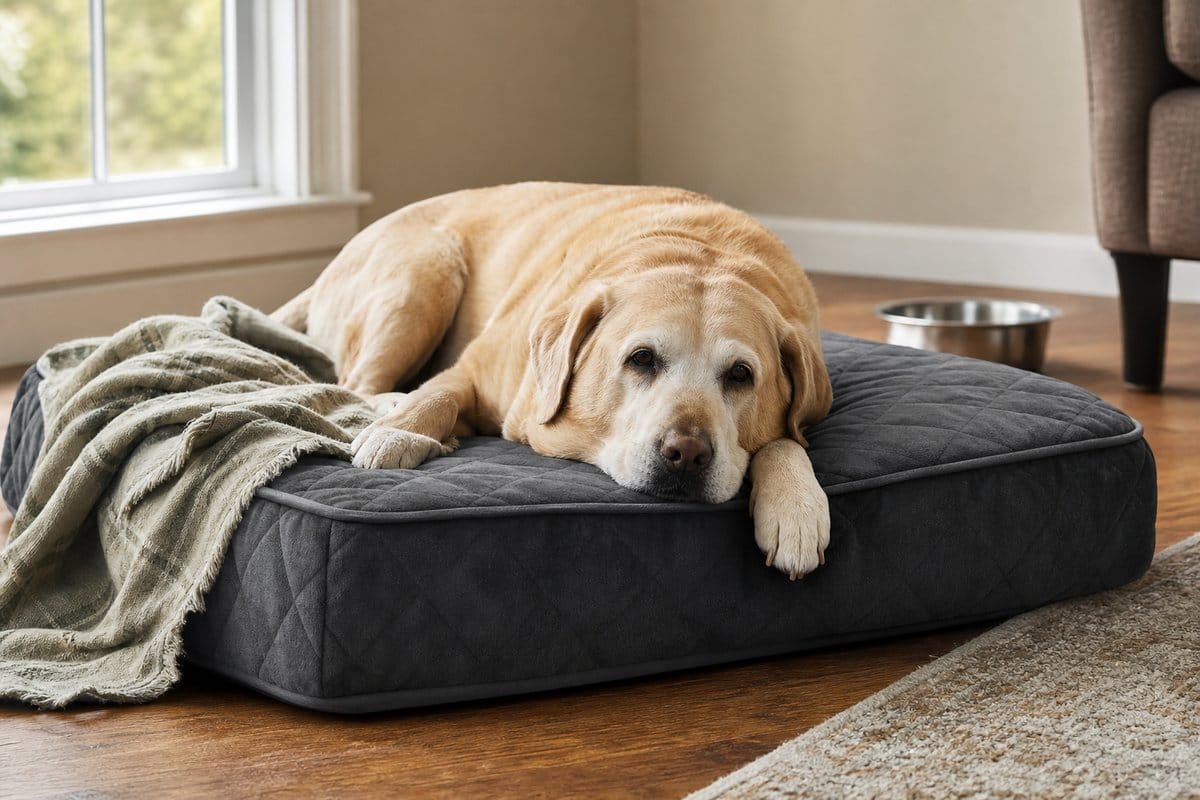
Big dogs put big stress on a bed. A 70 to 100 pound dog that sleeps 12 to 14 hours a day compresses foam, flattens pillows, and slowly grinds down whatever surface you set out. If you have ever watched a senior Labrador circle three times, drop heavily onto a flat cushion, and then struggle to get back up, you already understand why the bed matters more than the food bowl for long-term comfort.
This guide walks through how to choose a sensible orthopedic dog bed for a large breed. It is for owners who want a calm, informed purchase, not for shoppers chasing the thickest or most expensive option on the listing page. The goal is to match the bed to the dog in front of you, not to the photo on the box.
Why large breeds need more support
Large and giant breed dogs carry more weight on the same joint structure as smaller dogs. Their hips, elbows, and shoulders bear the load every time they stand, lie down, or shift while sleeping. Over time, that constant pressure on a thin or worn-out surface contributes to calluses, stiff mornings, and visible difficulty rising, especially in senior dogs.
Joint-heavy breeds include Labradors, Golden Retrievers, German Shepherds, Boxers, Rottweilers, Mastiffs, Great Danes, and Bernese Mountain Dogs. Larger mixed breeds share the same concerns. Excess weight makes things worse, which is one reason a thoughtful weight management plan and a supportive bed usually go hand in hand.
A good orthopedic bed does not cure arthritis, but it can reduce pressure points, give a dog a stable surface to push off from, and make it easier to stand up after a long rest. For anxious dogs, a defined, cozy space also fits a calming routine, similar to helping a pet with separation anxiety: predictably, in the same spot, with the same smells.
What "orthopedic" actually means
The word gets used loosely. In practical terms, an orthopedic dog bed holds the dog's weight without bottoming out, supports the spine and hips in a neutral position, and stays supportive after months rather than weeks. Anything softer is just a cushioned mat.
You will see three foam types in this category, each with tradeoffs.
- Egg crate foam. Light, cheap, fine for puppies and young adults. It flattens fast under a large breed, so skip it for seniors.
- High density polyurethane base with a memory foam top. The workhorse construction for most large breed beds. The dense base carries the weight, the memory foam spreads pressure, and the bed keeps its shape. For a Lab, a Boxer, or a senior Shepherd, this is the right starting point.
- Solid memory foam (4 to 5 inch slab). Heavier, pricier, slower to ship, but it gives the most even support. A good choice for giant breeds, dogs with diagnosed hip or elbow issues, and any dog who has clearly bottomed out on thinner beds.
You do not need to chase the highest density number. What matters is whether the bed has a solid, dense base that does not collapse within a few months. If you can press your palm fully into the foam with little effort, it is too soft for a large breed.
Sizing, shape, and the easy mistake to avoid
Measure your dog from nose to base of tail, then add 6 to 8 inches. That is the minimum interior length you want when the dog is fully stretched out. For most large breed adults, you are looking at an XL or XXL bed. If your dog curls up tightly when sleeping, you can subtract a couple of inches; if they sprawl, add more.
Shape matters more than people expect. A bolster or raised edge looks cozy in photos, but a tall bolster can become a barrier for a dog with reduced mobility. A flat or low-bolster mattress is friendlier for senior dogs, dogs with arthritis, and any dog who has started to drag a back leg. Round nest-style beds are fine for curlers; rectangular mattresses are better for sprawlers.
Two practical checks before you buy:
- Weight your dog, then read the manufacturer's weight range. If your dog is at the top of the range, size up.
- Look for a non-slip bottom. Hardwood, tile, and laminate floors turn a heavy bed into a sled the moment a senior dog tries to push up from it. A rubberized or grip-dot base is not a luxury, it is a safety feature.
Cover, fill, and the realities of a large dog
Large dogs are hard on beds. They shed, drool, track in dirt, and occasionally have accidents. A cover that can be removed and washed is the single most useful feature on a large breed bed, and it is the one that gets cut most often to hit a lower price.
Look for a zipper that runs around three sides, a fabric that can go in a home washing machine, and a liner that protects the foam from moisture. Waterproof liners are worth the upcharge if your dog has accidents or heavy drooling. You can browse large dog beds that are specifically waterproof to see how the better options build that layer in.
For dogs who run hot, a cooling top layer or a breathable cover helps during summer. A bed that does not trap heat is easier to settle on. If your dog is a senior or short-coated, cooling options sized for large breeds are worth a look. For older dogs specifically, the category narrows to beds designed for older dogs, which usually combine a low profile, a stable base, and a washable cover.
Where to actually put the bed
Placement is the part nobody talks about. A few rules from watching dogs ignore expensive beds:
- Put the bed where the dog already chooses to rest, not where you want them to rest. If your dog sleeps in the hallway, the hallway is the right answer.
- Avoid drafts from doors, vents, and windows that get opened at night. Senior dogs stiffen up in cold air.
- Keep the bed out of direct afternoon sun for dogs with thin coats or skin sensitivities.
- Make sure the dog can step on and off the bed without climbing. A bed raised on a thick platform is harder on joints than one flat on the floor.
If you are setting up a bed for a newly adopted dog, the placement question is part of the broader household setup. Our pre-adoption household checklist covers the rest of the room-by-room thinking.
How to introduce a new bed
Dogs do not always trust a new bed, especially if they are used to the couch or your bed. A few small moves help:
- Place the new bed next to the old favorite spot, not in a new room. The dog should not have to choose between you and the bed.
- Put a worn t-shirt or a blanket that smells like the household on top of the new bed for the first few days.
- Toss a treat on the bed during calm moments, and feed a stuffed chew, like a stuffed Kong, on the bed so the dog associates it with good things.
- Do not force the dog onto the bed. A dog who is shoved onto a bed will avoid it.
Most dogs settle on a new bed within a week. If your dog refuses after two weeks, the bed is probably in the wrong place or the wrong shape, not the wrong price.
When to replace
Even a good orthopedic bed wears out. Replace the bed when any of the following show up:
- You can feel the floor through the foam when the dog is lying down.
- The bed stays compressed in the shape of the dog and does not bounce back overnight.
- The cover is torn, no longer waterproof, or smells even after washing.
- Your dog is starting to avoid the bed in favor of the hard floor. That is a sign the bed has stopped helping.
For a healthy adult, expect 2 to 4 years from a well-made bed. For a senior or a dog with joint issues, plan on replacing every 18 to 24 months. Replacement covers are easy to find in standard sizes and cheaper than a whole new bed.
Safety notes for senior and disabled dogs
A few extra considerations if your dog is aging, recovering from surgery, or has a known mobility issue:
- Choose the lowest profile bed you can find. The less a dog has to climb, the less risk of a slip on the way down.
- Pair the bed with a non-slip rug or runner along the path the dog uses to reach it. The floor between bed and room is usually the bigger hazard.
- Keep the bed away from stairs. A disoriented senior dog can wander into a stairwell at night.
- Watch for pressure sores on elbows and hips. A dog who lies in one position for hours may still need to be repositioned.
- Talk to your vet before switching beds around a recent orthopedic surgery. Some post-surgical dogs need a specific surface for a few weeks, and a thick new bed can be the wrong call.
For broader planning around an aging dog's care, our vet tech's perspective on pet insurance is a useful starting point.
Putting it together
A simple shortlist: a high density base with at least an inch of memory foam on top, sized XL or larger, a removable washable cover, and a non-slip bottom. Skip the cheapest egg crate options for seniors and giant breeds, and do not pay extra for "orthopedic" labels that do not name the foam type.
You can browse orthopedic dog beds for large dogs and filter from there. The right bed is the one your dog actually lies on, sleeps through the night on, and gets up from more easily than before. Everything else is marketing.
As an Amazon Associate, TrustyPetSupplies earns from qualifying purchases.