First Turtle? What You Need to Know Before Bringing One Home
Turtles can be excellent pets, but they are not cheap, low-maintenance starter animals. Here is what first-time owners should know about housing, UVB, diet, hygiene, and long-term care.
Thinking about getting your first turtle? Good. Slow down for a minute. Turtles can be fascinating, long-lived pets, but they are also messy, expensive, and much easier to care for poorly than people expect. A tiny turtle in a little plastic bowl is not a real setup. It is usually the start of a sick animal and a frustrated owner.
As an Amazon Associate, Trusty Pet Supplies may earn from qualifying purchases.
Before choosing a turtle, step back and confirm the household fit. The practical adoption checklist can help you compare time, budget, housing rules, veterinary access, and long-term care before you commit.
This guide focuses mostly on aquatic turtles because they are the ones many new keepers see in pet stores and rescue listings. Land turtles and tortoises have different requirements, and even aquatic species are not interchangeable. A red-eared slider, painted turtle, musk turtle, map turtle, and cooter can all have different adult sizes, swimming habits, basking needs, temperatures, and diets. Before you buy supplies, identify the species and research the adult size, not the baby size.
Turtles are not short-term pets
A healthy turtle may live for decades. That is wonderful if you are ready for it and unfair to the turtle if you are not. Plan for years of water changes, bulb replacements, vet care, diet adjustments, and enclosure upgrades. If you are still deciding whether a pet fits your home, it may help to think through the same long-term questions covered in our pet adoption process guide: time, budget, household safety, and what happens if your life changes.
Also be careful with impulse purchases. In the United States, federal law bans the sale and distribution of turtles with shells under 4 inches as pets. That rule exists largely because tiny turtles have been linked to Salmonella outbreaks. Buy legal-sized turtles from reputable breeders, rescues, or shops that can tell you the species and basic care history.
Start with adult size, then choose the tank
One of the most common mistakes is buying a tank for the turtle you see today instead of the turtle you will have in a few years. Many aquatic turtles get far larger than new owners expect. A rough starting point often used for aquatic turtles is about 10 gallons of water per inch of shell length, but species, activity level, filtration, and layout all matter. A 5-inch turtle may need something in the 40 to 55 gallon range, and larger adults may need much more.
That is why a 20-gallon turtle kit should not be treated as a forever home. At best, it may be a limited juvenile or temporary setup for the right species and size, and even then you still need to check whether the included filter, lighting, dock, and heater are actually suitable. If you are shopping from scratch, it is usually smarter to look at larger options such as an aquatic turtle tank 40 gallon kit search and compare what is included instead of assuming a starter box solves everything.
Your turtle needs enough water depth and swimming room to move normally, turn around, dive, and climb out safely. The habitat also needs secure access to a dry basking area, enough air space above the dock, and a lid or layout that prevents escapes. Turtles are stronger and more determined than they look.
Clean water is not optional
Aquatic turtles produce a lot of waste. More waste means dirty water, odor, irritated eyes, skin problems, shell issues, and extra work for you. A small decorative filter is usually not enough. Choose strong filtration rated for more than the water volume you are using, because turtle tanks are dirtier than fish tanks of the same size.
You will still need regular partial water changes. A filter does not make waste disappear. It helps process and trap it until you clean the filter media and replace some water. Many owners also use water testing to keep an eye on ammonia, nitrite, nitrate, and general water quality. If the tank smells bad, looks cloudy, or leaves slime everywhere, the answer is not perfume or a cute accessory. The answer is better maintenance.
Water temperature is also species and life-stage specific. Some adult aquatic turtles are often kept around the mid to upper 70s Fahrenheit, while hatchlings may need warmer water, but do not treat that as universal advice. Check care guidance for your exact turtle and confirm concerns with an exotics veterinarian. Too cold can affect activity, digestion, and immune function. Too warm can create stress and water quality problems.
Basking, UVB, and heat need to be done correctly
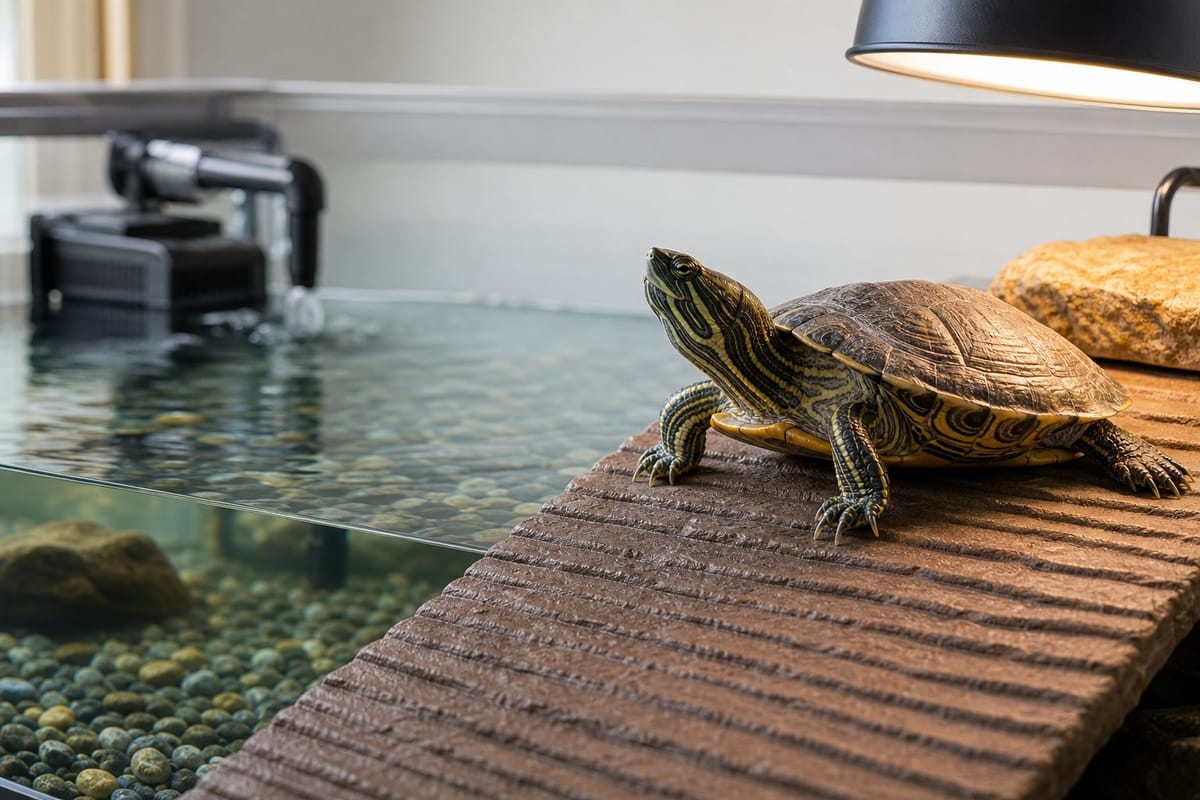
An aquatic turtle needs a dry basking dock where the whole body can leave the water and dry off. Not partly dry. Not balanced on a slippery rock with wet feet. Fully dry. Basking helps with temperature regulation, digestion, and shell health. The dock should be stable, easy to climb, and large enough for the turtle as it grows. If you are comparing parts, this aquatic turtle habitat, filter, UVB, and basking dock search can be a useful starting point for seeing the categories you need to evaluate.
UVB lighting matters because turtles need it to make vitamin D3, use calcium properly, and support healthy bones and shell development. UVB does not pass through glass well, so placing a bulb over a glass lid can make it almost useless. Screen lids can also reduce output depending on the mesh. Follow the bulb and fixture instructions, place the light at the correct distance, and replace UVB bulbs on schedule. Many bulbs lose useful UVB output long before the visible light burns out, often around six months, but follow the manufacturer for the specific bulb.
Heat lamps need just as much attention. Use the correct fixture, stay within wattage ratings, secure the lamp so it cannot fall, and keep it away from curtains, bedding, plastic trim, and anything flammable. Clamp lamps that are barely hanging on are a fire risk. Use thermometers to monitor basking and water temperatures instead of guessing by touch.
Good UVB, calcium, and diet support shell and bone health, but they do not magically prevent every shell problem. Shell rot and other infections can involve poor water quality, injuries, inadequate drying, and other health issues. Soft shell, pits, bad odor, discharge, swelling, bleeding, appetite changes, or a turtle that suddenly acts weak or hides constantly are reasons to contact an exotics vet.
Feed the turtle you actually have
Turtle diets vary by species and age. Many juveniles need more animal protein than adults. Many adults, depending on species, need more plant matter than new owners expect. Pellets can be useful, but they should not be treated as a universal complete diet for every turtle forever.
A commercial aquatic turtle food such as Fluker’s Buffet Blend Aquatic Formula Turtle Food can be one part of a feeding plan for suitable aquatic turtles, but it is not a substitute for species-specific research. Some turtles may also eat appropriate greens, aquatic plants, insects, worms, or other foods depending on the species. Supplements may be needed, but too much of a vitamin or mineral can also cause problems. If your turtle will not eat, eats only one favorite food, or grows oddly, get advice from an exotics vet or an experienced reptile professional.
Hygiene and household safety
All turtles can carry Salmonella even when they look healthy. This is not a reason to panic, but it is a reason to be strict. Wash your hands after touching the turtle, tank water, food, filters, decorations, or any equipment. Keep turtle supplies out of kitchens, sinks used for food prep, dining areas, and places where baby bottles or dishes are washed. Do not kiss, snuggle, or put a turtle near your face.
Children should be supervised around turtles, and turtles are not recommended for every household. Public health guidance warns that pet turtles are not a good fit for children under 5, adults 65 and older, or people with weakened immune systems. If you have a high-risk person in the home, talk with a doctor before bringing a turtle into that environment.
What a first turtle setup usually includes
For most aquatic turtles, expect to budget for a properly sized tank or tub, strong filtration, a water heater if the species needs it, thermometers, a secure dry basking dock, UVB lighting, a heat lamp, timers, water conditioner if appropriate for your local water, testing supplies, cleaning tools, food, supplements if recommended, and an exotics vet fund. This can easily cost several hundred dollars before you even bring the turtle home.
Reptile housing has a learning curve. If you want a broader look at enclosure thinking, our guide to snake enclosures is not turtle-specific, but it does reinforce an important point: the animal’s adult size, heat, humidity, security, and daily behavior should drive the setup, not the other way around.
Never release a pet turtle
If you cannot keep a turtle, do not release it into a pond, creek, park, or neighborhood lake. Released turtles can die, spread disease, compete with native wildlife, or become invasive. Contact a reptile rescue, animal shelter, exotics veterinarian, local herpetological group, or reputable keeper who can help with rehoming.
The blunt version is this: if you want a turtle because it looks cheap, small, and easy, choose a different pet. If you are ready to research the exact species, buy the right equipment, keep the water clean, replace bulbs, practice careful hygiene, and commit for decades, a turtle can be a rewarding animal to keep. Do the boring preparation first. Your turtle’s health depends on it.